Insights · D2C Marketing
Step-by-Step: The D2C Marketing Process Explained
A clear, step-by-step breakdown of how a well-run D2C Marketing program actually operates.
By the Pinwheel team · · 751 words
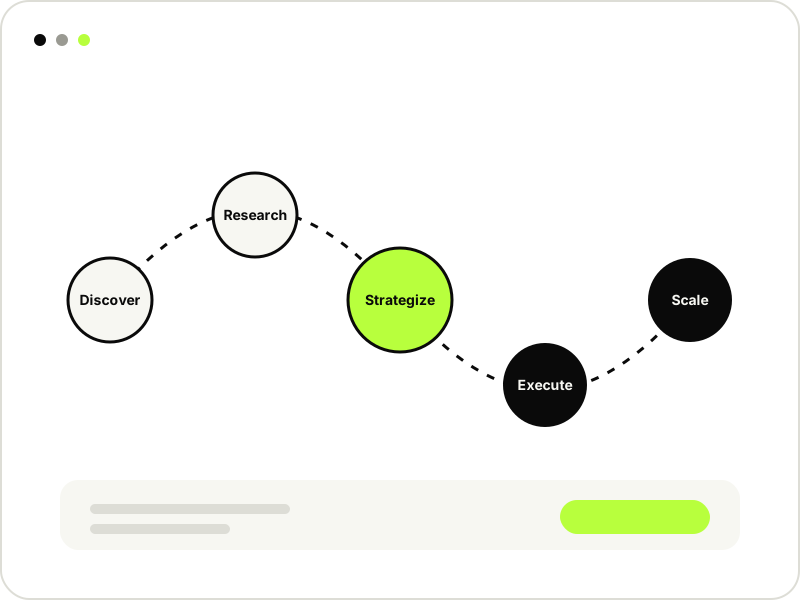
1. Discover
Understand the business, audience and current performance before recommending anything.
2. Research
Analyze competitors, Meta & Google Ads data and audience behaviour to find the real opportunities.
3. Strategize
Build a plan across performance marketing and paid acquisition and the other relevant disciplines, tied to specific goals.
4. Execute
Launch the agreed D2C Marketing activity, tracked from day one so results are measurable.
5. Optimize
Review performance on a regular cadence and adjust budget and creative toward what's working.
6. Scale
Expand what's proven into new channels, audiences or budget once the pattern is consistent.
The channels that carry most of the work
In a typical D2C Marketing program, Meta & Google Ads and Owned website carry most of the day-to-day activity, while Email/SMS/WhatsApp lifecycle and Influencer and creator partnerships tend to support specific parts of the funnel rather than running as standalone efforts. Understanding which tool is doing which job makes it much easier to diagnose a program that isn't performing, rather than assuming the whole approach needs to change when usually only one piece does.
How the pieces fit together
Performance marketing and paid acquisition and Website conversion rate optimization usually come first, since later work depends on getting them right. Subscription and retention strategy and First-party data and CRM strategy build on that foundation, and are where most of the ongoing, month-to-month effort tends to go once the initial setup is in place. Skipping the order and jumping straight to the later pieces is one of the more common reasons D2C Marketing underperforms relative to the effort put into it.
Should a D2C brand also sell on marketplaces?
Many do, to extend reach, but typically position their own site as the primary relationship and margin driver, using marketplaces as a secondary acquisition and trust channel.
What's a realistic customer acquisition cost (CAC) for a D2C brand?
It depends entirely on your margin structure and LTV; we model this from your own numbers rather than applying a generic industry benchmark.
How do you build brand loyalty for a D2C brand?
Through consistent brand experience, responsive customer service, a strong post-purchase email/SMS sequence, and community-building via social and content.
What role does subscription play in D2C marketing?
For applicable categories, subscription models improve predictable revenue and LTV significantly, and are supported through dedicated retention and win-back campaigns.
How this connects to E-commerce Marketing
D2C Marketing rarely works in isolation. It's closely connected to e-commerce marketing. Turn store traffic into repeat customers, not just one-time buyers. Businesses that plan the two together, rather than treating them as separate budgets and separate teams, tend to get more out of both.
How this looks in E-commerce
In e-commerce, D2C Marketing typically has to account for rising paid acquisition costs across search and social, which shapes both the channel mix and the pace of the program compared with a generic playbook applied to any business regardless of sector.
Where D2C Marketing sits in a full marketing plan
D2C Marketing rarely operates as a standalone effort inside a mature marketing program. It usually feeds data to, and draws budget decisions from, whatever else is running alongside it, so the businesses that get the most out of D2C Marketing are the ones who plan it as part of a wider system rather than a siloed line item with its own separate goals and its own separate reporting.
Signs it's working
The earliest reliable signal that D2C Marketing is on track usually isn't a headline metric moving, it's cleaner data: consistent tracking, a shrinking list of open questions about what's driving results, and a team that can explain, in plain language, why last month's numbers looked the way they did. The headline metric tends to follow once that foundation is solid.
Signs it's not working
The clearest warning sign isn't a bad month, individual months are noisy, it's a program where nobody can explain why performance moved, where the same questions keep coming up unanswered, or where more budget is proposed as the fix to every problem regardless of what the data actually shows.
What changes between month one and month six
Early on, most of the value in D2C Marketing comes from getting the basics right: tracking, a clear baseline, and a first round of performance marketing and paid acquisition. By month six, the focus shifts toward refining what's already shown signal and quietly retiring whatever hasn't, which is usually where the more meaningful gains start to show up in the numbers that matter.
FAQs
What makes D2C marketing different from general e-commerce marketing?
D2C specifically emphasizes owning the entire customer relationship and data, and typically leans harder into brand storytelling and community than marketplace-dependent e-commerce sellers can.
How important is customer lifetime value (LTV) for D2C brands?
Central — since acquisition costs on paid channels keep rising, sustainable D2C growth depends on maximizing repeat purchase and LTV, not just the first sale.